Diagnostics · May 16, 2026
DEXA Scan in Bali: Where to Get One and How to Prepare
Where to get a DEXA body-composition scan in Bali, how to prepare, what the report shows — and when a quick InBody test is all you need.
By the Bali Longevity Tour editorial team · Medical topics reviewed for accuracy; not medical advice
Short answer: in Bali, whole-body DEXA scans are done in hospital radiology departments, mostly in the Denpasar–Sanur area, and you should call ahead to confirm that the machine runs a whole-body composition scan, not only a bone-density check. Book it in the morning, skip calcium supplements for 24 hours and wear clothes without metal. If you only want to track a trend over a few weeks, an InBody test is cheaper and good enough; if you want visceral fat, lean mass by limb and bone density measured precisely, you need DEXA. On our 14-day retreat both are included.
Where to Get a DEXA Scan in Bali
DEXA is a medical imaging test, so it lives in hospitals rather than gyms or wellness studios. In Bali that means the radiology departments of the larger private and international hospitals, most of them in Denpasar and Sanur, where the island’s new international hospital sits inside the health special economic zone. Two practical points save a wasted trip:
- Ask for “whole-body DEXA, body composition”. Many machines are used mainly for bone densitometry of the hip and spine. That scan diagnoses osteoporosis but does not give you fat and lean mass.
- Ask who interprets the report. A printout full of percentiles is only useful if a physician explains what your visceral fat and lean-mass numbers mean for you.
Scans are usually booked through the hospital’s check-up or radiology desk; some require a doctor’s referral, which the hospital can issue on the day.
DEXA Scan Price in Bali
Prices are set by each hospital and change with the package, so treat any number you read online as a rough guide and ask the radiology desk for the current rate for a whole-body composition scan. A stand-alone DEXA is usually far cheaper than the same scan in Australia, the US or Europe, but the real saving comes from combining it with blood work and a physician consultation in one visit. On the retreat, DEXA with a re-test on day 13 is part of both packages — see packages and pricing.
How to Prepare for a DEXA Scan
- Avoid calcium supplements for 24 hours before the scan.
- Tell the hospital if you have had a barium study or a scan with contrast dye in the previous week or so, or if you could be pregnant.
- Wear light clothing without zips, underwire or metal buttons, and remove jewellery.
- For a comparable re-test, repeat the scan at the same time of day, in the same hydration state and on the same machine.
The scan itself takes a few minutes lying still on a padded table.
Why the Scale Lies to You
Bodyweight is one of the least useful numbers in health. It tells you how much you weigh, but nothing about what you are made of. Two people at the same height and weight can have wildly different metabolic futures — one carrying dense muscle and low visceral fat, the other carrying little muscle and a fatty liver.
In our experience with guests arriving in Sanur, the number on the bathroom scale has usually been the source of years of misplaced worry or false comfort. What actually predicts how you age is your composition: how much lean muscle you carry, how much fat sits around your organs, and how strong your bones are. That is where body composition testing earns its place, and why we build it into the first days of the retreat.
What DEXA Actually Measures
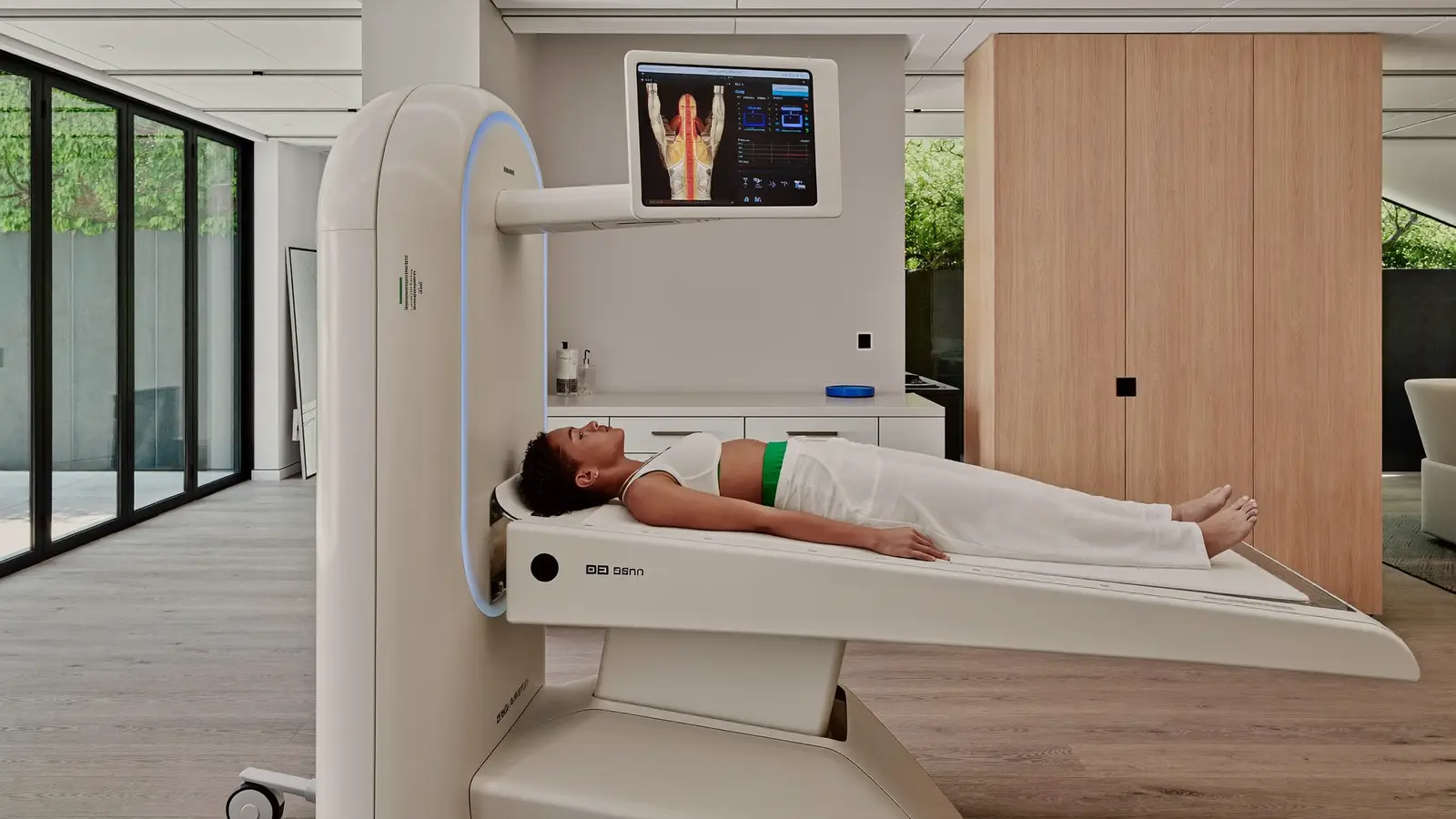
DEXA (dual-energy X-ray absorptiometry) is the reference standard for a reason. It passes two low-dose X-ray beams through the body and measures how each tissue absorbs them. Because bone, fat and lean tissue attenuate X-rays differently, the scan can separate them with real precision.
What you get from a good DEXA report:
- Regional fat distribution — arms, legs, trunk, and crucially the android (abdominal) region, mapped separately rather than lumped into one number.
- Visceral adipose tissue (VAT) — an estimate of the fat wrapped around your internal organs.
- Lean mass by limb — useful for spotting asymmetry or age-related muscle loss (sarcopenia).
- Bone mineral density — the same measurement used to diagnose osteopenia and osteoporosis.
The radiation dose is tiny — roughly a fraction of a single day of natural background exposure. The trade-off is that DEXA requires a machine, a technician, and a clinical setting, which is why it lives inside a comprehensive health check-up rather than in your living room.
What InBody (BIA) Does — and Doesn’t
InBody and similar devices use bioelectrical impedance analysis (BIA). A small, safe current runs through the body; because lean tissue (which holds water) conducts electricity better than fat, the device estimates composition from the resistance it measures.
The strengths are obvious: it is fast, non-invasive, needs no radiation, and costs a fraction of a DEXA. That makes BIA excellent for frequent tracking — it is genuinely useful for watching a trend over weeks.
The honest limitation is hydration sensitivity. Because BIA infers fat from water content, anything that shifts your fluid balance moves the reading:
- A salty meal or a big glass of water the night before
- A hard workout or a sauna session
- Time of day, and even where you are in a woman’s cycle
In our experience, a single InBody reading can swing by a percentage point or two for reasons that have nothing to do with real fat change. It reads the trend well; it is weaker at a precise one-off snapshot.
Why Visceral Fat Is the Number That Matters for Longevity
Subcutaneous fat — the kind you can pinch — is largely cosmetic. Visceral fat is metabolically active and behaves more like an organ that misfires. In studies it is consistently linked to insulin resistance, chronic low-grade inflammation, and cardiovascular risk, often independent of overall bodyweight.
This is why a lean-looking person can still carry meaningful metabolic risk, and why visceral fat sits at the centre of any serious longevity assessment. Reading it alongside your blood biomarkers — fasting glucose, triglycerides, an inflammatory marker or two — turns a single scan into an actual metabolic picture rather than an isolated data point.
DEXA on Our 14-Day Retreat: How We Use Both
We do not treat DEXA and InBody as rivals. They answer different questions, so we use them together.
- DEXA on arrival gives the precise, clinical baseline: regional fat, visceral fat, lean mass and bone density, interpreted by the hospital’s physicians.
- InBody through the two weeks lets us track the direction of travel frequently and cheaply, without repeated radiation.
- A re-test on Day 13 closes the loop before you fly home.
A word of honesty here: fourteen days will not transform your bone density, and any visible fat change over two weeks is small and partly water. What the re-test genuinely shows is direction — early shifts in hydration, lean mass and habits that, sustained at home, compound into the results that matter. The scans are there to give you an accurate starting line and a credible trajectory, not a miracle before-and-after.
If you want to see how this fits the wider fortnight, the full 14-day program lays out where diagnostics, movement and recovery sit day by day, and the medical check-up in Bali page lists every test in the diagnostic block. The point of measuring well on the way in is simple: you cannot manage what you have never honestly measured.
DEXA in Bali: Quick Answers
Where can I get a DEXA scan in Bali?
In the radiology departments of larger private and international hospitals, mostly in Denpasar and Sanur. Ask for a whole-body DEXA for body composition, not only a hip-and-spine bone-density scan.
How do I prepare for a DEXA scan?
Skip calcium supplements for 24 hours, wear clothes without metal, and tell the hospital about recent contrast studies or possible pregnancy.
Is InBody as accurate as DEXA?
InBody is good for tracking a trend but is sensitive to hydration; DEXA is the reference for visceral fat, lean mass by limb and bone density.
This article is educational and not medical advice. All diagnostics referenced are performed by licensed hospital and laboratory partners and interpreted by qualified physicians.
See this in the 14-day program
Every topic in this journal is a working part of the retreat protocol.