Cold & Heat · June 6, 2026
The Beginner's Guide to Ice Baths: How to Start Safely
A calm, practical, step-by-step guide to your first ice baths — get cleared, start warm, master the exhale, and progress without ego or injury.
By the Bali Longevity Tour editorial team · Medical topics reviewed for accuracy; not medical advice
Almost every beginner mistake with ice baths comes from the same place: treating it as a test of toughness rather than a skill to be learned. In our experience guiding first-timers, the people who stick with cold — and get the real benefits — are the ones who start slow, warm and calm. Here’s how to do exactly that.
First, get medically cleared
This is not a formality. A cold plunge is a genuine cardiovascular stressor: the shock triggers a sharp spike in heart rate and blood pressure as your vessels clamp shut. For most healthy people that’s a manageable, even useful stimulus. For some, it isn’t.
Before your first immersion, get sign-off from a doctor if you have any cardiovascular condition, uncontrolled blood pressure, arrhythmia, or are pregnant. On the retreat, this is precisely why cold always follows the Day-2 medical check-up — we screen before anyone touches the water, never the other way around.
Start at 10-12°C, not 4°C
The internet loves a 4°C plunge with ice cubes floating on top. Ignore it. For a beginner, water around 10-12°C delivers the full neurochemical response — the mood and focus lift — with far less of the panic that makes people quit. The physiology of the ice bath doesn’t require extreme cold to work; it requires a real cold signal your body respects, and 10-12°C is plenty.
Learn the exhale before you get in
The single most important skill isn’t cold tolerance. It’s the slow, controlled exhale.
When cold water hits your skin, your body’s automatic reaction is the cold-shock reflex: a sharp gasp and rapid, shallow breathing. Give in to it and your heart rate soars and the whole thing becomes a fight. The trick is to breathe out long and slow the moment you enter, then keep your breathing quiet and nasal.
Practise this on dry land first. A little focused breathwork before you approach the water rehearses the exact response you’ll need — and it’s why we teach breathing separately, standing safely on the deck, never as a breath-hold in the water.
Keep it short: one to three minutes
Duration is wildly overrated. Most of the benefit arrives in the first minute or two. For your first sessions, aim for 1-3 minutes and get out while you still feel in control. There is nothing to prove by shivering for ten minutes, and plenty to lose.
Frequency: two or three times a week
You don’t need daily cold to see results. In studies and in our own coaching, a realistic rhythm of two to three sessions a week is enough to build the adaptation and hold the mood benefits, while leaving your nervous system time to recover between exposures.
Warm up naturally afterwards
Resist the immediate hot shower. If your goal is the metabolic and resilience effect, let your body rewarm on its own — a few minutes of gentle movement, dry clothes, a warm drink. That natural rewarming is part of the training. (Contrast work with a sauna is different and deliberate; that’s a structured protocol, not a rescue from feeling cold.)
Progress slowly — add time before cold
Here’s the rule we give every guest: add time before you add cold. Get comfortable at 12°C for three minutes before you drop to 10°C. Change one variable at a time. Consistency beats bravado, every single week.
Common beginner mistakes
- Going too cold, too soon — chasing 4°C on day one.
- Holding your breath — the opposite of the skill.
- Hyperventilating beforehand — never combine breath-holds with water.
- Ego-driven duration — staying in to win, not to benefit.
- A scalding shower straight after — undoing the adaptation.
When NOT to do ice baths
Cold is not for everyone, and honesty matters more than enthusiasm here. Avoid or defer cold exposure — and speak to a doctor first — if you have a heart condition, uncontrolled hypertension, an arrhythmia, Raynaud’s, are pregnant, or are unwell. If in doubt, get cleared. The benefits of cold plunge therapy are real, but never worth an avoidable risk.
Do it with guidance the first time
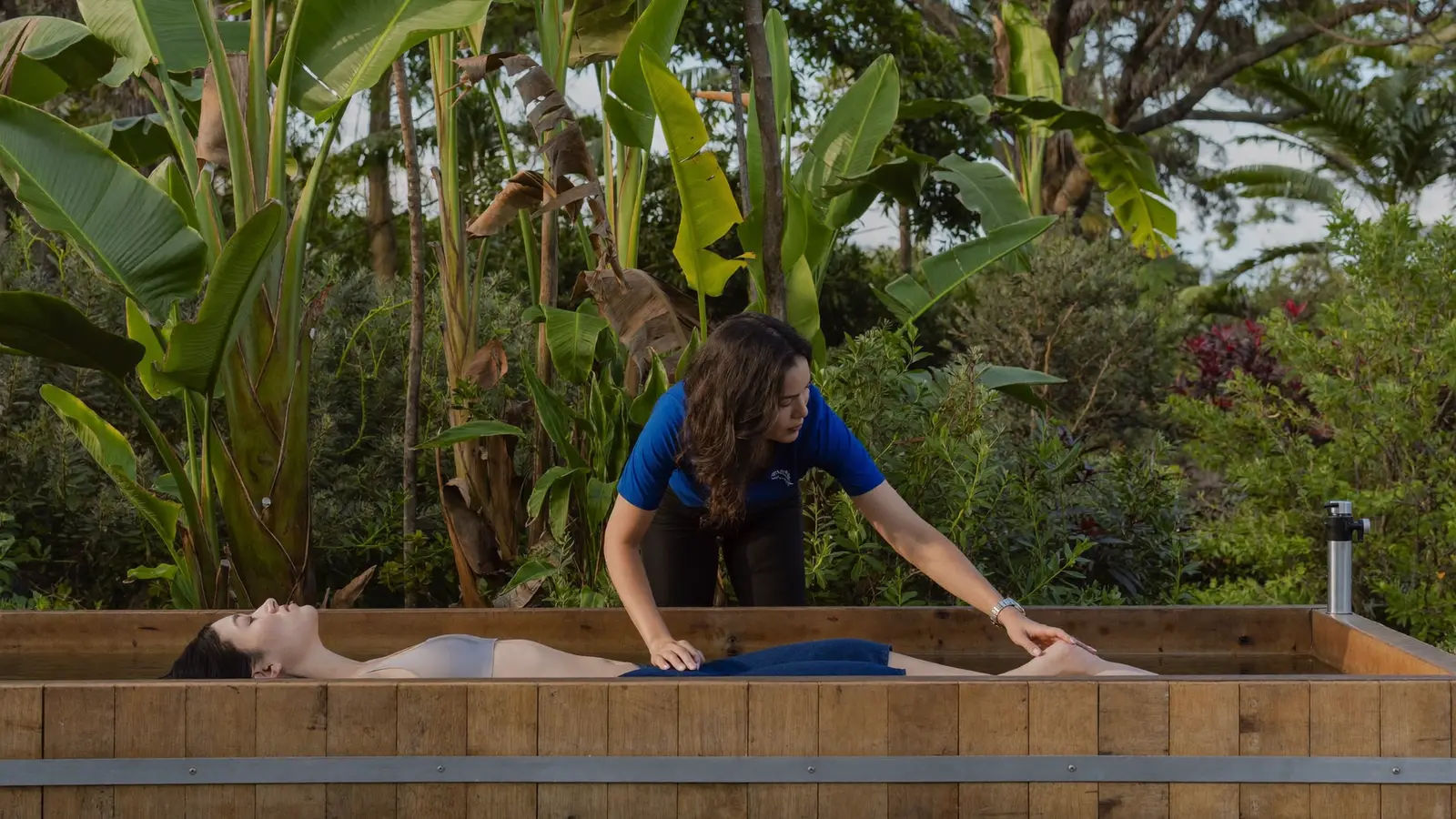
There’s no substitute for a calm voice talking you through your first exhale in the water. That’s the whole point of learning it properly rather than alone in a cold garden. On the retreat in Sanur, your first immersion is supervised, screened and unhurried — see the ice bath and sauna module for how we build it session by session.
Educational only, not medical advice. Cold exposure carries real risks for people with cardiovascular or other conditions; the retreat screens and supervises all cold protocols. Never practise breath-holds in or near water.
See this in the 14-day program
Every topic in this journal is a working part of the retreat protocol.